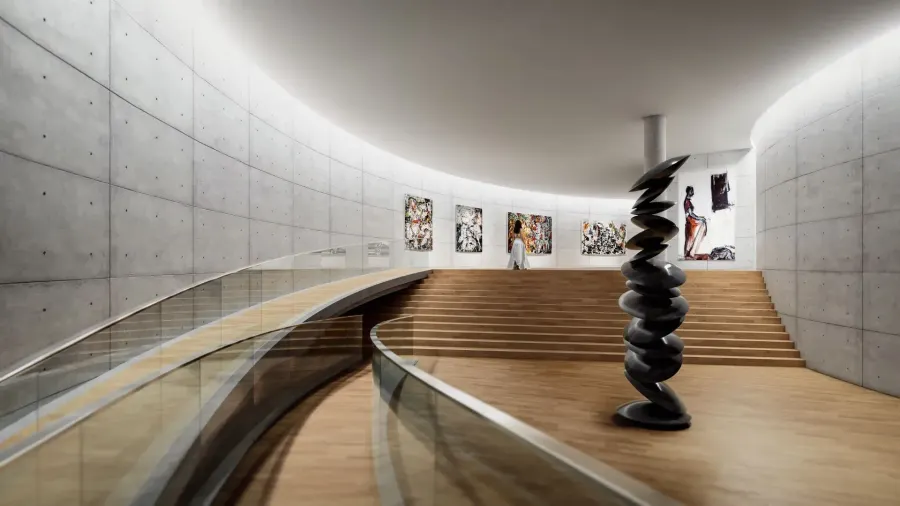
Dubai's first art museum is being built by a family business. The Dubai Museum of Art, unveiled last October, is being developed by the Al-Futtaim Group, the conglomerate better known for its car dealerships, consumer goods and finance. Tadao Ando, a former boxer who taught himself architecture and won the Pritzker in 1995, designed it as a five-storey curved shell on a jetty in Dubai Creek. Sheikh Mohammed attended the unveiling and thanked Abdullah and Omar Al Futtaim by name. There is no opening date yet, and no word on how the collection will be assembled.
Culture has tended to arrive in Dubai this way, with private money going first and the institutions following. Alserkal Avenue turned warehouses in industrial Al Quoz into the city's gallery district. The Jameel Arts Centre came from a family foundation. Art Dubai, founded in 2007, held its twentieth edition in May after a postponement caused by the regional conflict. It drew more than 25,000 visitors, a record for its public days, and galleries reported strong sales. Collectors are increasingly buying artists who live and work in the emirate, and new galleries keep opening across the city, some of them in malls.
The state is building as well. In May, Sheikha Latifa launched the Museum of Digital Art, the first in the region, due in 2029 as part of the financial centre's expansion into Zabeel. The Dubai International Financial Centre is building it, and its chief executive, Arif Amiri, also chairs Art Dubai. The Museum of the Future closed to visitors in September for a complete overhaul and is scheduled to reopen in the first quarter of 2027.
Down the coast, Abu Dhabi has chosen the other model: government-funded institutions with famous Western partners. Its agreement with the Louvre now runs to 2047. On 11 December the Guggenheim opens on Saadiyat Island, twenty years after it was announced, as the largest museum in the Guggenheim network.
Ando's museum will open to a city that already turns up for art.