
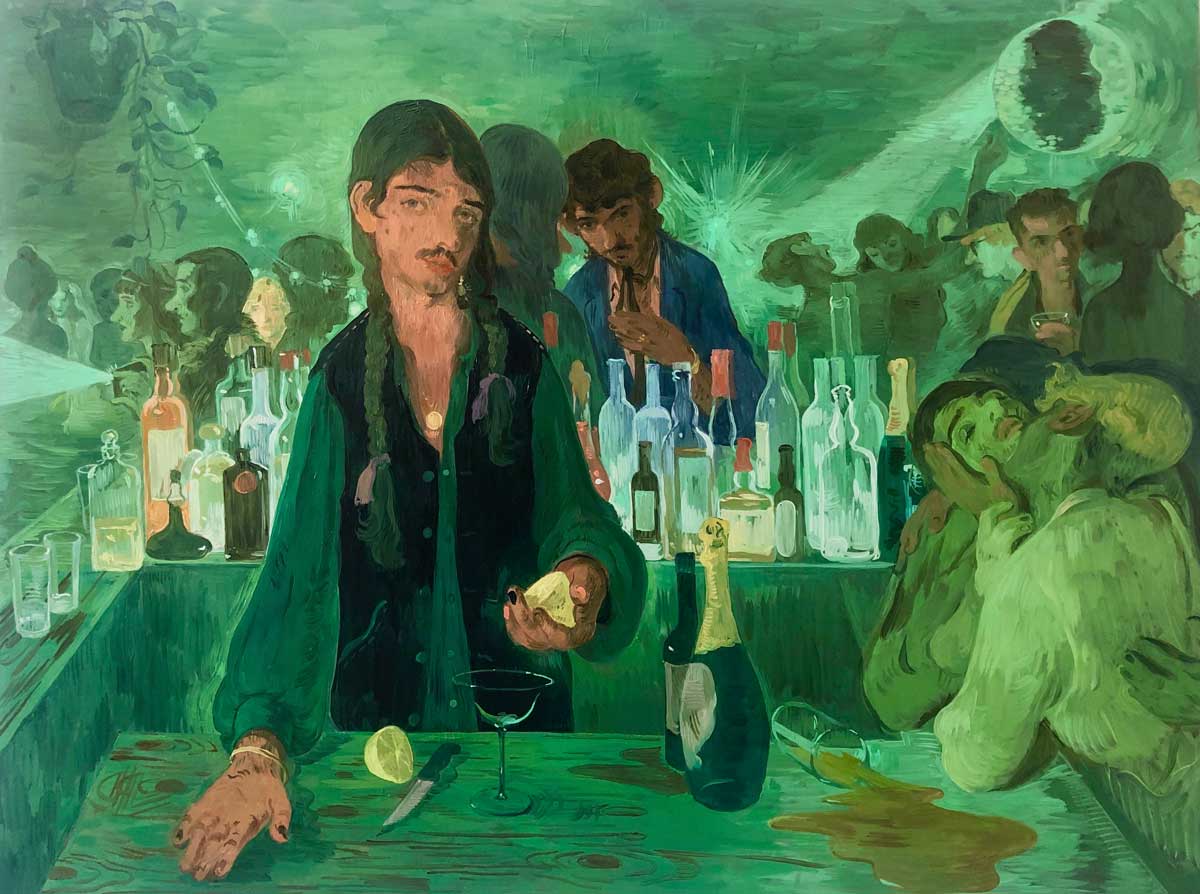
The barmaid in Édouard Manet’s A Bar at the Folies-Bergère has spent the best part of a century and a half being looked at. She stands behind a marble counter with bottles and a bowl of oranges in front of her, and in the mirror at her back a man in a top hat leans in to say something. Her face gives him nothing. People still come to Somerset House to stand in front of it and decide what she is thinking.
Until 10 January she has company. In The Bar on East 13th (2019), Salman Toor moves the counter to a New York bar and gives it to a bartender with braids, a gold bangle, painted nails and ribbons, slicing a lemon in a room washed green. It is one of 19 paintings, all made since 2019, in Someone Like You, the Lahore-born, New York-based painter’s first solo exhibition in Europe.
Toor has described his subject as the daily cost of being visible, and the pictures are precise about where that cost falls. Bar Boy (2019), one of what he calls his “coming out pictures”, puts a young man in a crowded club with his face lit by his phone. Everyone around him has come out for the night. He is reading something.
The same year, Toor began a series about US border control as a Pakistani traveller might have met it after September 2001, drawn from his own experience. In Man with Face Creams and Phone Plug (2019), a man waits with his head down while an official goes through his belongings on a table, and the viewer is placed roughly where the official would stand. Everything he has packed is on show, down to the moisturiser. None of it tells the official who he is. Elsewhere, new citizens take the oath with their hands on their hearts, the pose a state asks for shortly before issuing a passport.
Museums come in for the same attention. In Museum Boys (2021), first shown at the Frick beside two Vermeers, a pair of young men in a buckled wide-brimmed hat, a shawl and a pearl earring peer into a vitrine holding a pink shoe, a half-naked sleeping man and an upturned urinal. The Fag Puddles go further: heaps of the effeminate things Toor liked as a boy and was made to feel ashamed of, piled until they look ready to topple. In 2024 the Courtauld bought Fag Puddle in Vitrine (2021), now in the drawings display downstairs, and for this exhibition Toor has painted Fag Puddle with Carriers (2026), modelled on Lorenzo Lotto’s The Entombment, which the Courtauld also owns. An institution best known for teaching people how to look at paintings like the Lotto now owns a picture of what a boy in Lahore was taught to hide, arranged in a display case.
The attention arrived quickly. After his solo exhibition at the Whitney in 2020, Four Friends (2019) sold at Sotheby’s in New York in 2022 for about $1.5 million, and in 2024 he was in the main exhibition of the Venice Biennale. According to the curator, Elena Crippa, Toor felt the Whitney show had leaned too heavily on joyous communion, and this one is meant to cover more ground. It also shows his hand changing. He now holds the brush near the end of the handle, and in later pictures such as The Joke (2024), a dinner in an expensive restaurant, proportions slip and the diners begin to look like ghosts. As his audience has grown, his figures have become harder to make out.
He has had some practice at being read for more than a picture holds. In 2007, as a student at Pratt, Toor painted a teenage Zohran Mamdani, reportedly for the boy’s mother, the film-maker Mira Nair. When the portrait resurfaced during the mayoral campaign it was discussed in terms of destiny. On election night in November 2025, Toor reposted it.
The most exact looking in the exhibition is in the room downstairs. In a small sketchbook, a male nude seen from behind is drawn in tight pen strokes, with the kind of precision the paintings upstairs have been steadily giving up.
Salman Toor: Someone Like You, Courtauld Gallery, Somerset House, London, until 10 January 2027.