
In Abbeyleix, a small town in Ireland’s Midlands, chef Cúán Greene has turned a derelict Victorian house into a restaurant and guesthouse built almost entirely by people he already knew.
In September last year, Millbrook House was still without a roof. The Victorian building, once part of the de Vesci family's Abbey Leix estate, had spent years in decline. Its internal walls had collapsed, vegetation had taken hold and little remained beyond the original shell. By July, it had reopened as Ómós, a 16-bedroom guesthouse and restaurant.
The man behind it is Cúán Greene, a Dublin-born chef whose CV includes Geranium and Noma in Copenhagen and Bastible in Dublin. He had been developing the idea for Ómós since 2020, initially through a newsletter devoted to Irish food, producers and craft. The project found a physical home through John Collison, the Stripe co-founder who bought the neighbouring Abbey Leix estate in 2021. Collison had a derelict house and an interest in hospitality. Greene had a restaurant to build. It was a useful introduction.
There are other investors, among them Daire Hickey of communications consultancy 150 Bond and Strong Roots founder Samuel Dennigan. Greene remains the majority shareholder.
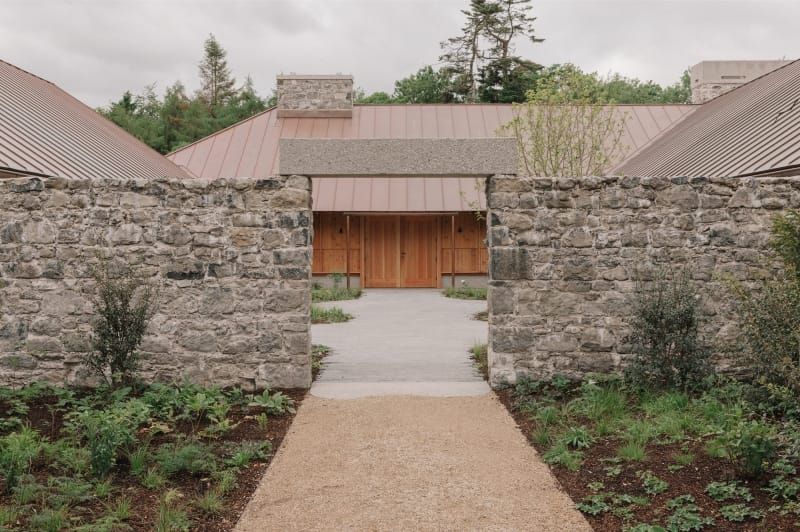
Architect Ryan W. Kennihan restored the 1885 house and designed the restaurant beside it. Only 700 new bricks were required for the restoration; the remainder were recovered from the original structure. The sash windows were reproduced in Meath, while the plaster mouldings and ceiling roses were reconstructed from surviving fragments. The staircase was relocated and an oval skylight introduced to bring daylight through the centre of the building.
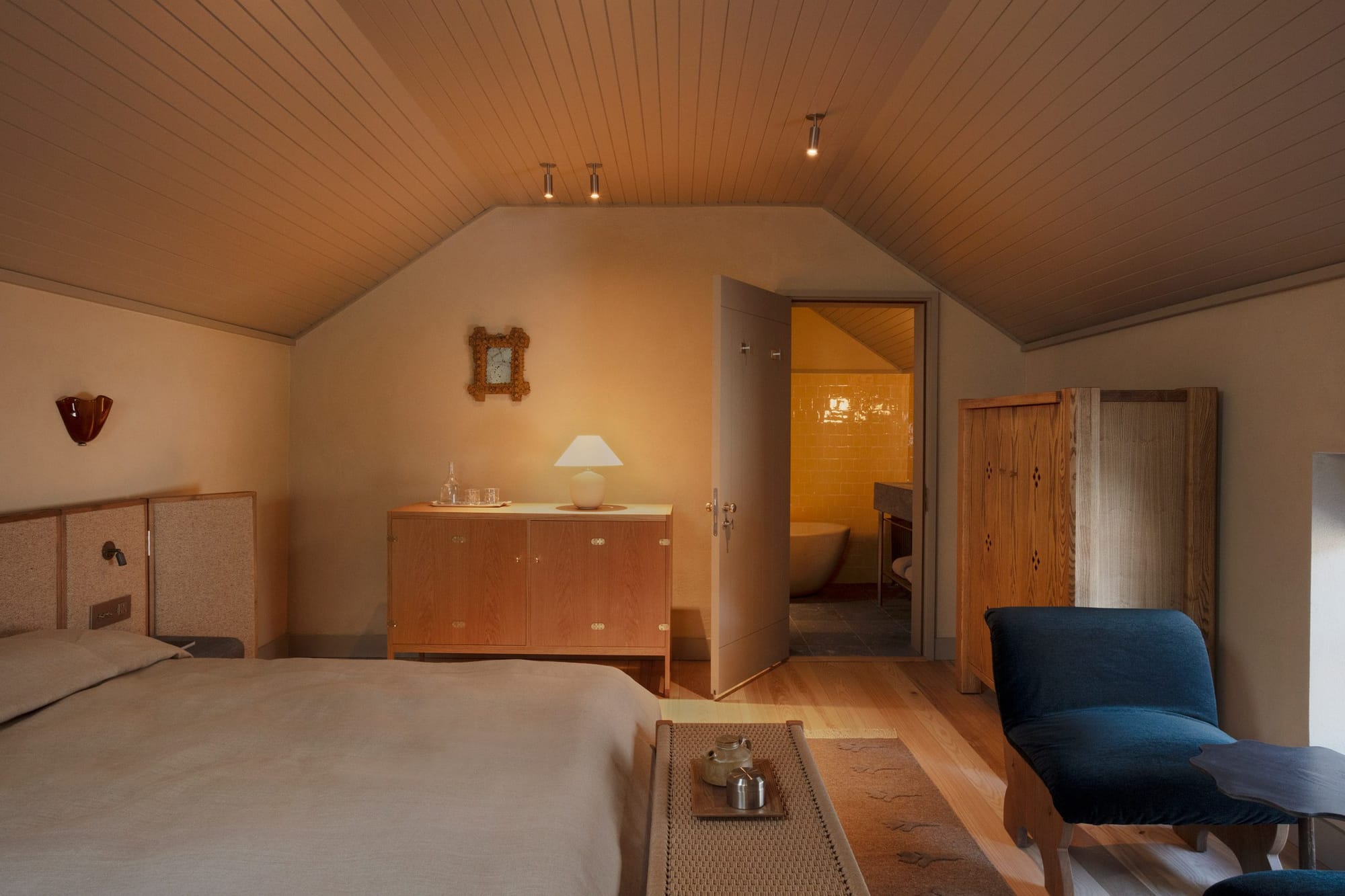
The interiors are the work of Copenhagen-based Asca Studio and Relief Gallery, whose designers spent three years developing the scheme. They travelled around Ireland studying furniture and meeting craftspeople.
There are ten bedrooms in the main house and six in the adjoining coachhouses. Mourne Textiles appear on upholstered headboards, Kilkenny limestone in the bathrooms and handmade Portuguese tiles in subtly different shades. Some suites have vast ceramic baths produced by Studio Loho in Belgium.
Kilkenny woodworker Eric Philips made the tables and benches for the breakfast room. Hanna van Aelst, who grows and weaves her own willow in Tipperary, made the baskets. Ceramicist Siobhán Joyce shapes her pieces over rocks from the Cork coastline.
Greene's mother, glass artist Róisín de Buitléar, made the drinking glasses, blown in Kilkenny and etched with motifs inspired by the local hedgerows. His father, typographer Terry Greene, supplied the name. Ómós translates as homage, duty and respect.
The bedrooms contain books, Irish linen, bodycare made for the house and a pair of Birkenstocks. There is Marvis toothpaste, rather than the usual anonymous miniature tube, and an honesty bar downstairs. The house scent was made with Dulcie. The art collection includes works by Louis le Brocquy, Maria Simonds Gooding and Damien Flood.
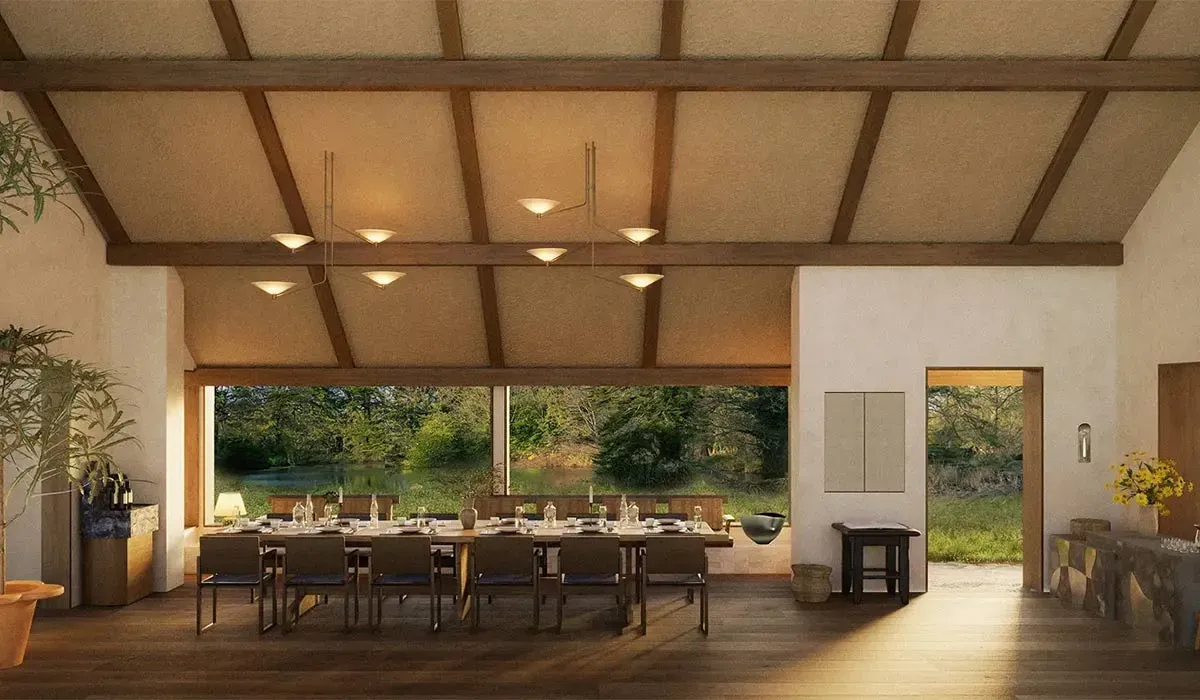
A short walk through the gardens leads to the restaurant, a contemporary building of reclaimed stone and Douglas fir beneath a copper roof. Its form borrows from traditional Irish farm buildings, with generous overhanging eaves and a vaulted interior. A limestone floor runs beneath exposed timber rafters, and the open kitchen sits at the centre of the room.
The tables and chairs were made by Greene's schoolfriend Michael Murphy, a woodworker based in Wicklow, using timber from a single oak tree. There is no conventional kitchen pass. Chefs bring dishes directly from their workstations to the dining tables.
Greene's years in Copenhagen show in the technique; the menu itself stays closer to home, reconsidering familiar Irish ingredients and dishes rather than importing Nordic gastronomy wholesale.
The household salad, that dependable arrangement of boiled egg, ham and whatever else happened to be in the fridge, appears with Mangalitsa pork and fermented barley salad cream. A tomato tart combines heritage-grain pastry, anchovy and summer fruit. Japanese fermentation techniques run throughout the menu, alongside ingredients from the restaurant's gardens and a network of farmers and producers built up over several years.
A single steamed potato arrives with Jersey butter, mint and lovage. It has attracted a considerable amount of attention for a vegetable that has already done quite well for itself in Ireland.
The tasting menu costs €175 per person. Wine, Irish cider and poitín feature among the drinks, while the kitchen has its own bakery and substantial provision for fermenting, preserving and ageing ingredients. The restaurant serves dinner from Tuesday to Saturday, with lunch on Saturdays.
Beyond the restaurant are 4.2 acres of gardens, woodland paths and a millpond. A Douglas fir sauna, inspired by traditional Irish sweathouses, is reached across a bridge formed from a single slab of Kilkenny limestone. The gardens supply the kitchen with vegetables, herbs and flowers, while offering an entirely reasonable excuse to spend the following morning outside.
Abbeyleix itself deserves some of the attention. The town has Bramley, a restaurant listed in the Michelin Guide, and Müller & O'Connell, a bakery and delicatessen occupying a former bank. Morrissey's, the pub on the main street, has been serving the town for generations. Greene held part of his wedding celebrations there and continues to point guests in its direction.
Rooms start from €395 a night, breakfast included. Booking a bedroom also secures a table in the restaurant, settling the principal question of what to do that evening.
Ómós is a great deal to build as a chef's first place of his own: a restored Victorian house, a purpose-built restaurant, a substantial collection of art and furniture, and a garden that will take years to look as planned. Almost none of it was made anonymously.
Sounds: Candelabra, piano and jazz for an evening around the table.
Ómós, Abbeyleix, County Laois. omos.co