
To reach the beach at Galé-Fontainhas, south of Comporta, visitors walk through a former campsite, leave their identity card at the gate and collect it on the way back. A campsite worker described the arrangement to Euronews in the summer of 2025. The campsite was bought in 2021 for about €25 million by Discovery Land Company, the American developer of CostaTerra, a resort of around 300 villas priced from roughly €4 million. One of its founders, Mike Meldman, started a tequila company with George Clooney.
Portugal has no private beaches. The environment minister said so in June 2025, after inspectors were sent to the 45-kilometre coast of Grândola. Of the 22 beaches they checked, nine had some form of restricted access, and one resort still under construction had been advertising a "private beach" on its website until the environment agency intervened. This spring, the agency's main announcement for Comporta beach was 60 new parking spaces.
For most of the last century, none of this was necessary. The houses that made Comporta's reputation were roofed in reed, a method borrowed from the huts of the rice workers and fishermen who were there first. The roads to the beaches were sand. Storks nested on the electricity poles. Visitors came for the Atlantic and found, with some relief, that nobody had arranged anything for them. There was very little to do, and that was rather the point.
That emptiness had an owner. In 1955 the Herdade da Comporta, some 12,500 hectares spread across seven villages, passed to the Espírito Santo family, whose bank was for decades among the most powerful institutions in Portugal. Tenant farmers worked the rice fields, many of them from childhood, and the estate later added wine, melons, sweet potatoes and pine nuts. It also kept close control of what got built. The restraint visitors admired as the character of the place was largely a land policy, set by people who had no need to sell.
Banco Espírito Santo collapsed in 2014. In November 2018, the 87 investors in the fund holding the estate's assets voted to sell, and in 2019 the deal closed at €157.5 million. The buyers were Vanguard Properties, owned by the French businessman Claude Berda, and Amorim Luxury, run by Paula Amorim of the cork family. Vanguard's chief executive has since put the average cost of a finished house on its land at €2.2 million to €3.5 million. The company is also building a chapel.
In October, the Portuguese newspaper Jornal Económico put a figure on what followed. Tourism and residential projects launched between Comporta and Melides since 2020 account for more than €5 billion in planned investment, and close to €9 billion if everything is completed. Spread across 45 kilometres of coast, that comes to roughly €111 million per kilometre, or €200 million if the plans survive intact.
The money has produced its own disputes. From October 2022, a road toward Praia do Pego, near Carvalhal, was closed by barriers put up by Casas da Encosta, a condominium of more than 50 villas. Vanguard and Amorim Luxury, which holds the JNcQUOI restaurant on that beach, went to court and claimed the closure was costing them €509,704.65 a month. In June 2025 a court in Setúbal ordered the barriers removed. The condominium replied that the road had never led to the beach at all, only to land Vanguard intends to develop. The public's right of way was argued, to the cent, by two parties, neither of which was the public.
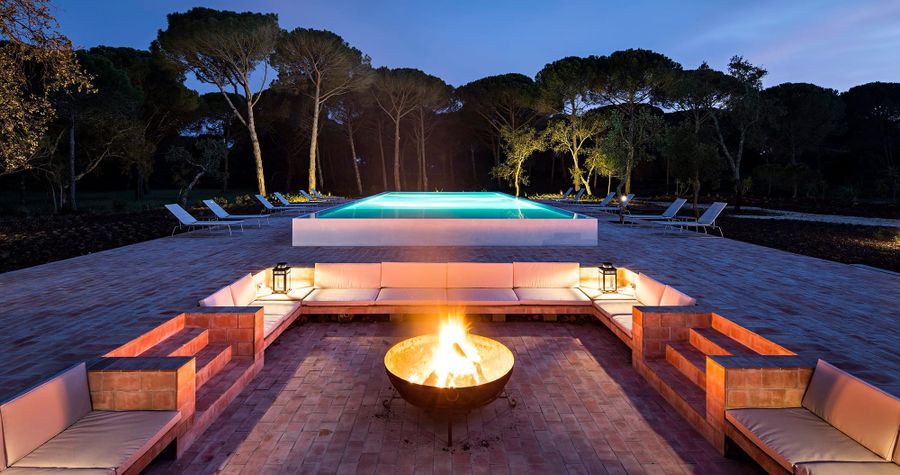
The international hotel groups are arriving on top of all this. In August, Hyatt and the Portuguese developer Coporgest announced Park Hyatt Comporta, a €220 million project with 58 rooms, six villas, 22 serviced residences and a golf course. It will be the first Park Hyatt in Portugal and is due in early 2029. Further south, on the Pinheirinho estate, Six Senses is building a 70-room hotel and 58 branded residences designed by Michaelis Boyd, the architects of Soho Farmhouse. Sales opened this year, ahead of a 2028 opening.
For decades Pinheirinho, whose name means "little pine tree", was private and visited by invitation only. Its developer says less than 5 per cent of its 400 hectares will be built on, and the plans include a sculptural path laid out for mindful walking. The chief executive of Six Senses has said the project will show that luxury "doesn't have to be taken too seriously." Both resorts offer what the old estate supplied by doing nothing: pine forest, privacy, a slower pace. A branded residence adds the reassurance of a recognised name, which is an odd thing to pay for in a place whose reputation rested on having so few.
Christian Louboutin got there before the money. "Comporta was a kind of paradise," he told the Financial Times in 2023, by which time he had moved down the coast to Melides. He opened Vermelho there that year: 13 rooms, gardens by Louis Benech, murals by Konstantin Kakanias, textiles by Carolina Irving and, in the rooms, slippers embroidered in the red of his soles. He also co-founded Intertidal Melides, a local group arguing for gentler tourism. The first designers and decorators came because the coast was ignored. Their houses and hotels are now part of the reason it isn't, and the newer projects are, in effect, pricing their taste.
For the people who live here, the price is easier to read. Jacinto Ventura, a farmer who heads a local association in Melides, told AFP last year that a small house worth €20,000 two decades ago is now valued at €1 million. A three-bedroom house of 90 square metres in Melides was recently listed at €880,000, close to €9,800 per square metre. At some beach concessions a parasol and two chairs cost €200 a day. "The people who really come from here don't really have a place," Tiago Quintas, 28, told Euronews. The municipality of Grândola has written the risk into its own long-term strategy, warning that tourism and second homes could produce "social and spatial segregation".
Then there is water. Proteger Grândola, a local association, counts more than 30,000 tourist beds planned for the municipality, alongside three new golf courses and new intensive avocado and tangerine farms. In 2024, farmers' associations representing more than 300 growers wrote to the regional authorities that Grândola and neighbouring Alcácer do Sal, once among the country's biggest producers of pine nuts, now produce effectively none, because the water table has dropped. The pine forest in every sales brochure is already short of water. The regional climate plan now includes desalination.
Some of the old coast still runs on its own terms. On the Sado estuary at Carrasqueira, a few kilometres from Comporta, fishermen built a pier on stilts in the 1950s and 1960s, each adding his own stakes and planks until the walkways ran for several hundred metres. It is still in use. At low tide nobody fishes from it, because the water no longer reaches the boats. Architects have noticed it too: at least one has designed a Comporta summer house inspired by it.
None of this makes the case against investment. Money brings jobs and infrastructure, and it gives young people a reason to stay in a region that has struggled to keep them. Prosperity, though, needs the people who live there to share in the gains. Turning a coast into a product can be done with considerably less consultation.
The developers' difficulty is that the empty coast is the thing they are selling, and every project slightly reduces the supply. When one family held most of the land, the view was kept by default. Now it depends on a dozen owners, each with a commercial reason to build and each relying on the others not to. Keeping it will fall to the planning authorities, which is not where the place's reputation came from.
There is still time. Several of the largest projects are years from opening, and decisions on housing, water and beach access can still be made before the buildings are finished. If they are not, the next visitors will find very good hotels, thoughtful restaurants and houses designed to disappear into the pines. Everything will have been thought of, including the impression that very little has changed.
If you go: the Address Book
Comporta is about an hour's drive south of Lisbon airport. A car is not optional. The coast is still worth the trip, and the best of it is at the edges: the stilt pier at Carrasqueira, the lagoon at Melides.
Stay
Institutions
- Casas na Areia, Carvalhal. Four thatched beach houses with sand floors, heated in winter.
- Sublime Comporta, Muda. A 17-hectare estate of umbrella pines and cork oaks. In May 2026 it nearly doubled in size with Sublime Sand, 43 villas with private pools.
Newer arrivals
- Vermelho, Melides. Christian Louboutin's first hotel. Thirteen rooms, from about €310 a night.
- Pa.te.os, Melides. Four minimalist villas by Manuel Aires Mateus, a short drive and a long way from Vermelho.
- Quinta da Comporta, Carvalhal. Designed by Miguel Câncio Martins beside the rice fields. The spa uses rice in its treatments.
Eat
Institutions
- Dona Bia, Comporta. On the road to Carvalhal. Family-run, with regional rice dishes, grilled fish and seafood. There is not always a table.
- Sal, Praia do Pego. Family-owned, on the dunes above the beach. It also runs the sunbeds below.
- Museu do Arroz, near Comporta. A former rice factory. Order the seafood rice.
Newer arrivals
- Cavalariça, Comporta. A former horse stable, with booths set into the stalls.
- Xtian, Melides. The restaurant at Vermelho, served on tableware made in the village.
See
- Cais Palafítico da Carrasqueira. Go at high tide, close to sunset.
- Lagoa de Melides. A wooden bird hide on the lagoon, sheltered from the heat and wind.
- Loja do Museu do Arroz. The rice museum's shop: backgammon sets, picnicware and leather aprons.