
For more than a century, Rioja’s wine capital has had an improbable habit of finding itself connected to the wider world. A new hotel suggests the visitors may finally be staying longer.
Haro has long had a grand little saying about itself: “Haro, París y Londres.” The town links it to its early embrace of electricity, a story that has not suffered from repetition. In 1890 Haro became one of the first Spanish towns to introduce electric public lighting, a novelty visible to passengers arriving by rail after dark. Another phrase survived from the period: “Ya llegamos a Haro, que se ven las luces.” We’ve arrived in Haro, you can see the lights.
Electricity did not make Haro important. It was evidence of what had already happened there. During the second half of the nineteenth century, oidium and then phylloxera devastated vineyards in France, sending French wine merchants south in search of replacement supplies. Some established export operations around Haro’s railway station, where the new rail connection had already begun changing how wine could leave the region.
The neighbourhood that developed around the station was working infrastructure rather than an attempt to create a picturesque wine quarter. López de Heredia established itself there in 1877, CVNE followed in 1879, Gómez Cruzado in 1886, La Rioja Alta in 1890 and Bodegas Bilbaínas in 1901. In little more than two decades, the basic shape of the Barrio de la Estación had emerged. Today its association describes it as the largest concentration of century-old wineries in the world.
This is the context for Palacio de los Ángeles, the five-star hotel that opened in Haro this year. The town has spent considerably longer building places for wine than places for the people who come looking for it.
The palace predates the great wine boom. Built in 1755 as a second residence for the Ángel family, wealthy merchants from nearby Ezcaray whose fortune came from wool, it accumulated less illustrious uses as the centuries passed. During the nineteenth century it served as an inn for muleteers; later there was a market, with homes on the upper floors. It was eventually divided into rental accommodation, then abandoned and, for a time, occupied. The carved family crest remained on the façade while the building behind it kept changing purpose.
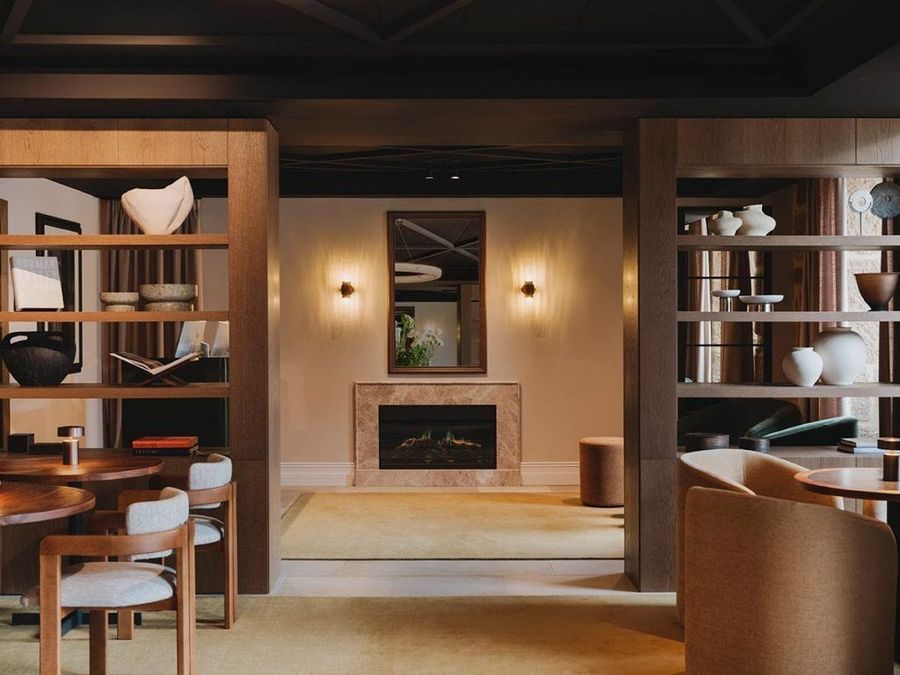
After more than three years of restoration, it now contains 38 hotel rooms. An adjoining building holds ten residences intended for longer stays, and Trenchs Studio has handled the interiors without trying to recreate an eighteenth-century palace room by room. Original stone and tiles survive beside contemporary furniture; beneath them, the old calado has returned to an association with wine.
The temptation with a hotel like this is to catalogue the expensive parts. There is a heated pool, a spa and a restaurant overseen by Carlos and Ignacio Echapresto of the two-Michelin-starred Venta Moncalvillo. The residences have kitchens. Someone has made a fairly substantial bet that visitors to Haro might want enough time and independence to need one.
That matters because Rioja has had sophisticated wine tourism for years. Its best-known producers no longer treat visitors as an interruption to the work of making wine, and tasting rooms have grown into restaurants, architectural projects and elaborate private experiences. Haro’s advantage is that much of the physical setting came before the tourism industry. Several of Spain’s best-known wine houses are neighbours because the railway once made that the practical place to put them.
Accommodation has been slower to carry the same weight. You could come to Haro because of López de Heredia, Muga or CVNE without thinking particularly hard about Haro itself; the town provided access to the cellars and the cellars supplied the occasion. Palacio de los Ángeles makes that distinction less obvious. Its position in the old centre puts the town and the Barrio de la Estación within the same compact stay, while the residences assume that at least some guests will want more than a night between tastings.
There is another indication that hoteliers have noticed the possibility. In August, Haro approved the works licence for a new four-star hotel to be managed by Vincci, with 52 rooms on a 7,000-square-metre property once occupied by a manor house and winery. It is scheduled to open at the end of 2027. One additional hotel does not amount to a transformation, but the investment is aimed at precisely the visitor Palacio de los Ángeles is beginning to accommodate: someone treating Haro as the destination rather than Rioja as an excursion.
Plenty of European places have learned to reverse-engineer themselves around tourism. Hotels arrive, local character is polished into something easily legible, and ordinary buildings acquire stories designed for visitors. Haro presents a more complicated proposition because most of what gives the place its character was built for other reasons. The railway, warehouses, underground cellars and wine houses existed to make, store and move something. Even the grand new hotel occupies a building that has already been a merchant family’s retreat, an inn, a market, housing and an empty shell.
That may be why “Haro, París y Londres” still suits the town. Haro never needed to resemble either city for the phrase to work; there was something slightly absurd and appealing about a small place in northern Spain putting itself in their company at all. Palacio de los Ángeles does not make Haro the next great European hotel destination. It does make arriving for the wine and staying for the town easier to imagine.