
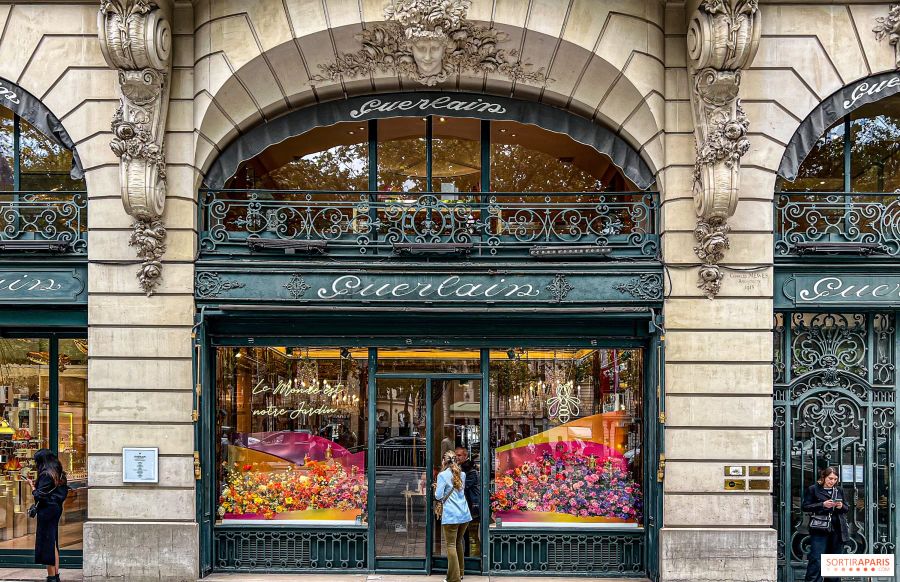
Guerlain has given a century-old name to a new perfume. Dior has spent the same season restoring the old ones. Both houses kept their originals on sale.
For more than a century, L’Heure Bleue meant one perfume. Jacques Guerlain made it in 1912, taking the idea, according to the house, from the light over the Seine as he crossed the Pont-Neuf one evening: the short interval after sunset when Paris has lost the day but not quite reached night. The smell was as hard to place as the hour. Anise, orange blossom, iris, violet and vanilla settled into a dry powder, beautiful without being especially cheerful.
Now it has a date. Since August, Jacques Guerlain’s perfume has been sold as L’Heure Bleue 1912. The name on its own belongs to a new composition by Delphine Jelk, the house’s director of perfume creation. Jelk’s perfume is built around an iris tincture Guerlain spent three years developing, with orange blossom, vanilla and an ozonic accord meant to suggest the chill of evening air. She has said Jacques Guerlain had no way of producing that effect in 1912, when synthetic molecules were only beginning to arrive. Guerlain calls the result a contemporary reinterpretation. It comes in a blue version of the inverted-heart bottle Baccarat first made for the original, and Guerlain has made it refillable.
Nothing has been discontinued, and anyone who wants the 1912 version can still buy it. The change is stranger than a reformulation or a flanker, because Guerlain has altered which perfume counts as the default. The original is now the historical one, and the new one gets the name.
Dior, meanwhile, has been doing almost the reverse. Francis Kurkdjian has restored 13 fragrances from the Dior archive for a collection called Dioriginals, among them Diorama, Eau Fraîche, Diorissimo and Diorella, and has tried to bring each one back towards what its perfumer intended. That is more complicated than pulling an old formula from a drawer. Ingredients are restricted or disappear, crops vary and extraction methods improve. Decades of small adjustments can carry a fragrance a long way from where it began without anyone ever deciding to redesign it. The restored versions come in the oval bottle Dior first used in 1948.
So two LVMH perfume houses are working out, at the same moment, what to do with fragrances that have outlasted the conditions in which they were made. Dior has gone into its archive looking for the original object. Guerlain has taken one of the strongest names in its archive and let it describe something new.
The contrast would be cleaner if Dior had always behaved like a conservator. It has not. Miss Dior was first the chypre launched in 1947 alongside Christian Dior’s first collection. That perfume still exists, but it is now Miss Dior Original, and the name Miss Dior has passed through a succession of newer fragrances. L’Heure Bleue becomes L’Heure Bleue 1912; Miss Dior becomes Miss Dior Original. In each case the oldest perfume remains available. What moves is the name.
Old houses seem to decide about their archives according to where the value has settled. Some old fragrances are valuable for the work itself. They can be restored carefully and sold to people who care what Edmond Roudnitska intended for Diorissimo in 1956. Others gather something larger around them. The name becomes familiar well beyond the perfume counter and collects advertising, celebrities, packaging, family mythology and decades of recognition. At that point, keeping the formula and keeping the name stop being the same commercial decision.
Guerlain seems to have concluded that L’Heure Bleue has reached that point. A new global fragrance is expensive and uncertain to launch, and a house needs a name, an image, a story and enough advertising to make people remember all three. L’Heure Bleue already has Paris, 1912, Jacques Guerlain and the inverted-heart bottle, along with more than a century of writing about all four. What it lacked was a new generation of customers. Guerlain does not need to persuade anyone that L’Heure Bleue matters. It needs to persuade them that it can mean something else.
Guerlain could have called Jelk’s perfume L’Heure Bleue Nouvelle, or L’Heure Bleue II, or almost anything else. Instead it gave the qualifier to Jacques Guerlain. There is a practical case for this: two perfumes cannot sensibly share a shelf under one name, and a year makes their relationship plain. It may even send people looking for the original. Still, one of the two now sounds like something retrieved from the archive, and it is not the new one.
For years, luxury houses talked about heritage as though its value lay in continuity. The house endured, the codes endured, and the founder’s handwriting turned up somewhere in the campaign. Heritage now behaves more like stock, to be edited, divided up, restored in one place and put to work in another.
A new brand cannot buy any of this. It can buy good marble, hire an excellent designer and open a beautiful shop remarkably quickly. It cannot acquire a first collection shown on the avenue Montaigne in February 1947, or a perfumer crossing the Pont-Neuf in 1912. History remains one of the few luxury materials that cannot simply be ordered, and archives have grown busy accordingly. Fashion houses bring back old bags and silhouettes, furniture companies return forgotten designs to production, and hotels uncover old logos and restore interiors to versions of themselves that may never have existed quite as elegantly the first time.
Perfume is harder, because there is no stable original to keep. A bottle of fragrance is not a chair. The label can stay the same for eighty years while the contents drift away from what somebody first smelled. The name survives more easily than the smell.